
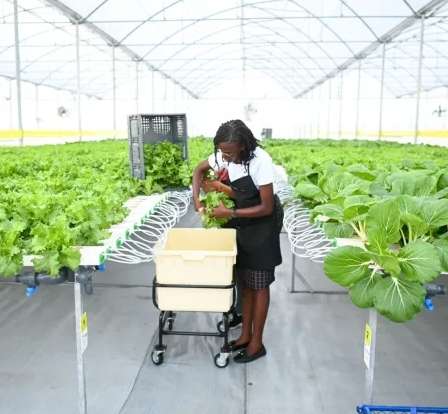
Under Guyana’s Ag. Ministry’s Innovation and Entrepreneurship Programme (AIEP), 603 shade houses were built between 2021 and 2024. This initiative was launched in 2021 by President Irfaan Ali to encourage youth involvement in agriculture.
Shade houses are structures covered with a material, such as mesh or netting, that provides partial shade while still allowing sunlight, air, and rain to reach the plants inside. They protect crops from harsh weather conditions like strong sunlight, wind, and heavy rain while creating a controlled environment for better plant growth.
Guyana uses shade houses to grow valuable crops throughout the year. These include vegetables like lettuce, cauliflower, broccoli, carrots, bell peppers, sweet peppers, and tomatoes.
Herbs cultivated are celery, cilantro, parsley, mint, basil, chives, dill, coriander, spinach, Swiss chard, kale, sage, oregano, and thyme. The country also grows hot peppers, such as bull nose and tiger teeth, mainly for export.
Shade houses help ensure consistent food production and extend the growing seasons, improving food security and reducing the need for imported goods.
Minister of Agriculture, Zulfikar Mustapha, shared during a recent press conference that 219 shade houses were constructed in 2024 alone. Beneficiaries included farming groups and government agencies.
Farmers in the AIEP hot pepper project built 25 shade houses, while another group built 67.
Additionally, 21 shade houses were constructed in public schools, six on farms, and three by the group ‘Coco Coffee.’ An orphanage built one, while a local group added 96 more.
Guyana also opened the largest hydroponics farm in the Caribbean at Mon Repos, capable of holding 100 seedlings. This project aims to cut the regional food import bill by 25% by 2025.
The National Agriculture Research and Extension Institute (NAREI) partnered with Victoria Green to launch a hydroponic greenhouse project supporting this effort. Minister Mustapha emphasized the importance of these developments for sustainable agriculture, economic growth, and food security.
Shade houses have helped establish Guyana as a rising food hub and offer youth a chance to earn income while contributing to eco-friendly farming.
Source: Guyana PIS.


